SLIDER

If You Give a Girl a Planner: Bookish Notebook

Nov 2, 2020

If you give a girl a planner, she's going to ask you for a pen, some stickers... and maybe a notebook to go with it. I'm so obsessed with all things paper! I love trying new things and then blogging about it. So, for the last few days, I've shared my 2020 planner lineup. I talked about what I've been using for my daily life, personal goals, and reading journal. Today, I'm wrapping it up with my favorite: my bookish bullet journal / notebook!


This notebook is from The Happy Planner line called Happy Notes. They come in different sizes, and this is the Classic. I believe they all have the mini size rings, three tabbed dividers, and 60 sheets of paper that are either blank, lined, or dot grid (depending on the notebook you choose). I usually buy dot grid because that's my favorite, but you can also buy refill paper in any style if you fall in love with a certain notebook but want different paper.

I usually refer to this as my bookish bullet journal, even though that isn't quite accurate. I tried bullet journaling but never got the hang of it. The format became time consuming for me because I tended to overthink it, but I loved the concept. That's when I got the idea to use my Happy Planner as a pseudo-bullet journal. Instead of drawing everything by hand, I'd make printable pages. And with the disc binding, it was easy to move pages around until I had it just right. It's basically my bookish notebook that's completely customized to me.

When I posted about this notebook back in 2018, I used actual Happy Planner pages for the bulk of my blog planning. Now, my entire notebook is printables that I made for myself. I'm so excited to show you some highlights! My reading notebook is divided into three sections, and I'll show you photos of a handful of pages from each section + will list out what other pages I've included in each. Here are the three sections:

+ Section 1: Challenges, TBR, and Trackers
+ Section 2: Blog Post Planning
+ Section 3: Brainstorming

Let's start at the very beginning!

SECTION 1: CHALLENGES, TBR, AND TRACKERS


GOODREADS CHALLENGE
The very first page of this section is for my Goodreads Challenge. I make my goal 100 books, even though I typically hit it long before the end of the year. I love having a goal but don't want to make it such a challenge that I become too focused on the quantity of what I'm reading versus the quality. When I finish a book, I draw a heart if it was a 4.5/5-start read, a check mark if it was a 3.5/4-star read, or a blue x if it was 3 stars or below. It's fun to see a quick glance to see how I've felt about what I've been reading lately. When I meet the goal, I fill in the date at the bottom.


MISC. CHALLENGES
Next are the pages for the various challenges that I've set for myself or joined. This changes from year to year! There are more pages than the two above, but they're all similar. Here's what you'll find in my 2020 notebook:

+ 2020 Re-Read Challenge: My goal was to re-read at least 12 books, so one per month. I had space to fill that in + an area to brainstorm potential re-reads. I'd completed this goal by May.

+ Picky Pledge Challenge: This is something Alexa and I do every year, which you can read about here. I've got all 12 categories listed with space to write what I've read for each. I've still got a few left to complete!

+ Non-Fiction Challenge: My goal was to read 12 non-fiction books in 2020 because I own a lot of non-fiction but don't frequently reach for it. I shocked myself by completing this goal in June (the letter after each title indicates the month I finished the book) and have finished an additional 16 non-fiction books since then. I'll redesign this page for 2020 so that it isn't tied to a specific month, since that wasn't how I ended up using it.

+ Read or Die Challenge: Alexa came up with this back in 2018, and I decided to do it, too. At the start of a new year, I list anything that's been on my shelves from before the previous year (for 2020, anything I've owned since 2018 or before) with the goal of reading it before the end of the current year. If I don't finish it, the idea is to cull it.

+ My 10 in 20: After my successful 10 in 2019 list, I decided to do it again in 2020. I picked 10 books from my TBR to focus on finishing this year. So far... this year might be a bust. I've only read three and DNF'd one. Whoops! 

After my Challenge pages, I have several pages devoted to my TBR based on the format of the books.


TBR: PHYSICAL BOOKS
First, I have pages dedicated to my physical TBR. I have three bookshelves in my notebook: one for my Non-Fiction TBR, one for Adult Fiction, and one for Young Adult & Middle Grade Fiction. The latter is pictured above. For all my TBR pages, I only write down the titles of books I own. I use Goodreads to save books I'm interested, but I only want to actively track the things I've purchased and plan to read. When I buy a book, I add it to my shelf. Once I've read it, I color it. If I DNF it, I just color it black. And when I fill up a page? I print a new one! 


TBR: E-BOOK
After making the bookshelf, I decided I wanted something else for my e-books. So, I made a Kindle TBR printable! I write digital review copies down on one printable and digital books I've purchased on their own. Since I try to read review copies by pub date, I like separating them. I do a green check when I've read a book and a red X if I DNF it.


TBR: AUDIOBOOKS
And finally, my favorite page in the TBR section is the audiobook printable I designed! I'm most proud of this page because I was able to replicate the look of the Audible app. I write down the title, author, narrator, and length in those spaces. And in the spot where the book cover would go, I color it orange when I'm done listening to a book and write down the date I finished it. And I only use this for audiobooks that I own, not library books!


SERIES TRACKER
The last few pages in this section are related to tracking things! Here's what I've got currently:

+ Book Spending Tracker: What I bought, where I got it, and how much I spent on it
+ Review Copy Tracker: Title, release date, and I've read, reviewed, posted about it, and sent to publicist
+ Series Tracker: Series name, author, number of books in series, and color what I've read so far
+ Movie/TV Tracker: Title, number of episodes (if TV), and whether or not I've watched it

Okay, that's all for my challenges, TBR, and trackers! Now, it's time for the blogging section.

SECTION 2: BLOG POST PLANNING 


MONTHS AT-A-GLANCE
With my goal to post on the blog twice a week, this is a quick way for me to see how I'm doing at a glance. With two months per side, I love that it only takes up three pages of space. This is my first year using these page, and I'm liking them so far! I don't plan out potential blog posts – just write down things I've published.


MONTHLY RECAP
I use the same categories in my recap posts every month, so I created a printable that I could fill in throughout the month. It's made it so much easier when it's time to write the post because I'm not looking in various places (photos / my planner / Goodreads / Spotify / etc.) to joy my memory. It's double-sided, and you can see both above.

The front has four categories: Loved (favorite memories), Read (just favorites, not a full list), Heard (music or songs I had on repeat), and Watched (TV or movies, old or new). For 2021, I'm going to try adding a fifth category: Bought, for writing down favorite purchases from the month. The back is for the books I acquired, since I always include that in my posts. I've divided it into five categories: Bought, Gifted, Gift Card, and Review. 


QUICK LIT
I don't think I had this page in 2018, and it's one of my favorite additions. I write down the title of books I finish that month, and then I have boxes to the right so I can mark when I've taken a Photo, written a Review, updated Goodreads, and Logged it in my reading journal. It's a simple but effective way to stay on track with reviewing what I've read.


END OF THE YEAR 
There are some posts that I write at the end of every year, similar to the way I post a Recap and Quick Lit every month. So, it was worth it for me to create printables for those posts! The first is my My Year In series, and I have pages for:

+ My Year in Books: My favorite reads each month
+ My Year in Adventures: My favorite memories and activities from each month 
+ My Year in Music: What I listened to each season 
+ My Year in Movies & TV: Movies and tv shows that were new-to-me or rewatches
+ My Year in Beauty: My favorite makeup, skincare, and hair products
+ My Year in Obsessions: My favorite finds throughout the year + a new page for baby/big boy faves

Plus two additional pages:

+ Favorite New-to-Me Authors: A Top Ten Tuesday topic that I do every December
+ Perpetual Page-Turner's End of the Year Survey: To fill in potential answers throughout the year 

And that's the end of my blogging section!

SECTION 3: BRAINSTORMING


DOT GRID BLANK PAGES
And finally, I have some blank dot grid pages behind the last tab. I love having blank paper to jot down ideas, flesh out discussion posts (like my favorite bookish memories in the photo above), or sketch potential printables to create for myself. 

Do you have a bullet journal or bookish notebook? 
Of all my planners, I think this one is my favorite!

If You Give a Girl a Planner: Reading Journal

Oct 30, 2020


If you give a girl a planner, she's going to ask you for a pen, some stickers... and maybe a notebook to go with it. I'm so obsessed with all things paper! I love trying new things and then blogging about it. So, for the next few days, I'm sharing my 2020 planner lineup. I'll talk about what I'm using for my daily life, personal goals, reading journal, and bookish bullet journal. Today it's all about my reading journal and log!


Back in 2017, I decided to start keeping a reading log. I wasn't always timely about writing reviews for the blog or Goodreads, and then I'd struggle to remember what I thought of a book when I was done. I looked at reading journals on the market, but most fell short for various reasons – like categories that I didn't want to fill in for every single book I read, too little or too much space, or not enough pages to last me a year. Enter Happy Planner!

The beauty of Happy Planners and the disc-bound planner system is that you can customize them. If you saw my post about my 2018 reading log, today's will look very familiar. The only real difference? The size! I was previously using a Mini but switched to a Classic for 2020. I wasn't sure if it would feel too big, but it's just right. I'll chat a little more about that below. This is a 12-month horizontal planner. Let's look inside!


NOTES PAGE
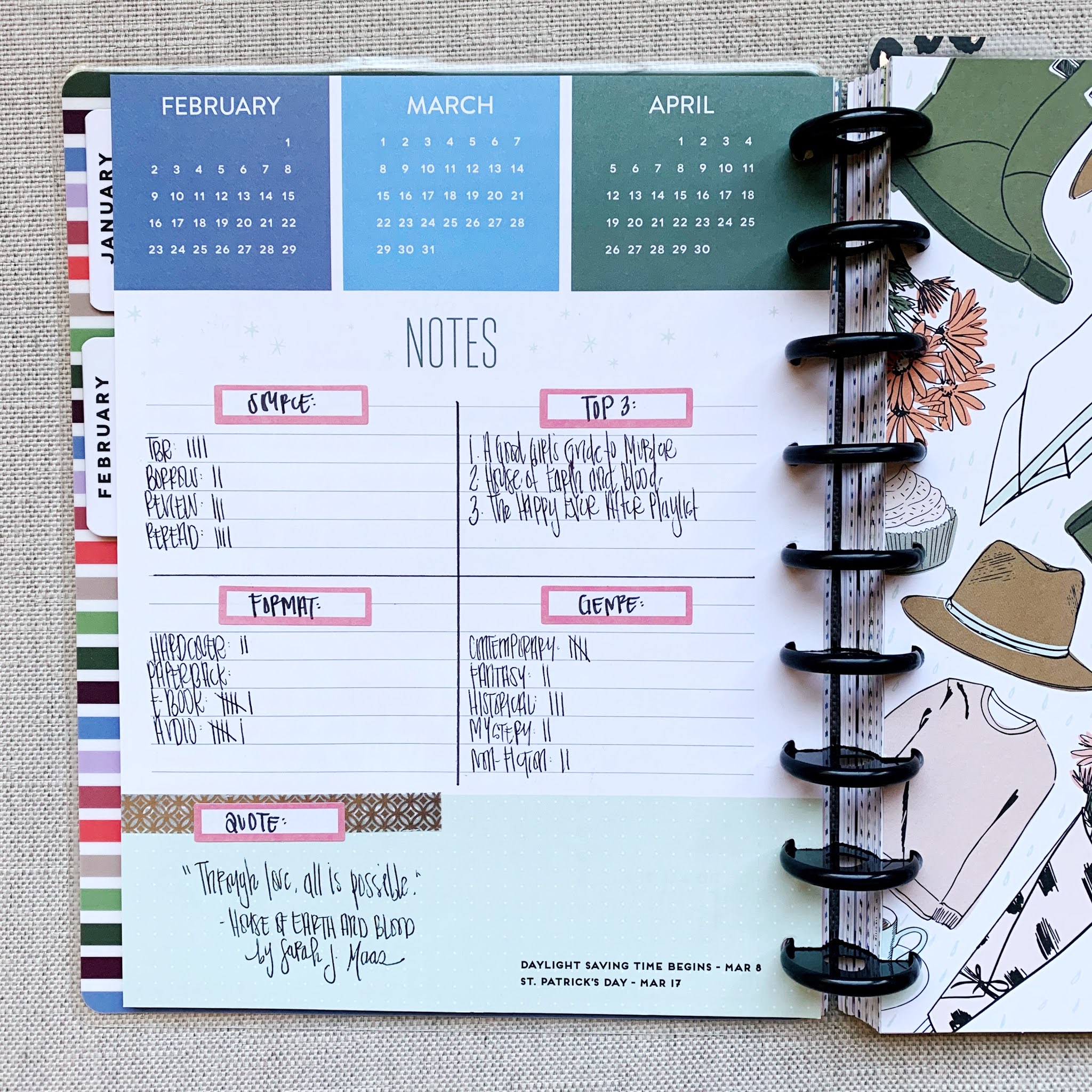
At the beginning of every month, there's a Notes page. Every Happy Planner has their own design for this page, so that usually influences which planner I choose for the year. I divide this into four sections with my pen and then use the colorful boxes stickers to add headings. This is where I track five things for that month's reads:

+ Source (TBR / Borrow / Review / Reread)
+ Format (Hardcover / Paperback / E-Book / Audiobook) 
+ Top 3 Reads of the Month
+ Genre (genres listed changed based on the month)
+ Quote (favorite from any book that month)

I love wrapping up the month by filling this out because it's a nice way to look back before diving in to new books.


MONTHLY CALENDAR
On the monthly calendar spread, I write down a book's title on the day I finished reading it. If I finish more than one book in a day, I just draw a line halfway through the box to split it up. It's super simple, but I love seeing the contrast between weeks where I only finished one book versus weeks where I was finishing a book a day. 


WEEKLY PAGES
And now we get to the heart of this planner: the weekly view! Happy Planners come in a lot of different formats, but I always buy the horizontal style for my reading log. It's just easier to write down my thoughts in a lined space. As I mentioned, I used to get the Mini size but switched to the Classic this year. I noticed in my Mini that my thoughts often sounded really shallow or repetitive because I didn't have the space to flesh them out at all. I loved that I stuck to the highlights, but looking back it felt like I couldn't write in full sentences or explain myself.

The Classic size has been nice because it gives me a little more room to go into detail but isn't as overwhelming as most things that are marketed as reading journals. I personally don't want a full page per book! I'd never keep up with it and would probably run out of pages in the notebook before the end of the year. This size and style is just right for me! On the day I finish a book, I write down:

+ The title and author
+ The format, source, and my rating
+ A few lines detailing what I thought of it

It isn't as polished as a review I'd share on the blog, but my reading journal has helped me when I've gotten behind on reviews. The bones are there! If I finish more books in a week than there are days, I'll add in a Happy Planner half-sheet and use this same format. If I finish two books on a Saturday but nothing on a Sunday, for example, I'll white out Sunday's date, put washi tape over the line, and write Saturday's date with (Cont.) after it. 

And that's all I do in my reading journal! It's simple but effective for me, which is a huge reason I'm still doing the same thing I was in 2018. I don't want to mess with something that's working. I just wish I'd always kept one! I have one other notebook where I list what I'm reading, which I decided to include in today's post.


BOOKS READ NOTEBOOK
I mentioned this notebook in one of my Happy Planner posts but never added photos of it. I thought it would be fun to include here! I bought it from Books-a-Million almost ten years ago, and that's how long I've been using it. I write down what I read every month, and I love flipping through and seeing how many books I've read since 2011.


MONTHLY LIST
Here's a look at the inside! I circle the month at the top, write down the year, and then just list everything I've read that month. I have considered including ratings, noting re-reads, and other things, but I just prefer the simplicity. It's just a notebook of lists, and I love it.  

Do you keep a reading journal or log?
On Monday, I'll finish by showing you my bookish notebook!

If You Give a Girl a Planner: Goals

Oct 29, 2020


If you give a girl a planner, she's going to ask you for a pen, some stickers... and maybe a notebook to go with it. I'm so obsessed with all things paper! I love trying new things and then blogging about it. So, for the next few days, I'm sharing my 2020 planner lineup. I'll talk about what I'm using for my daily life, personal goals, reading log, and bookish bullet journal. Today it's all about my PowerSheets Intentional Goal Planner!


I'd never purchased a goal planner before but was intrigued by the idea of PowerSheets after following the company on Instagram. When they launched their 2020 collection, I decided to give it a try. With a baby on the way at the time, I worried that I'd use them for a month and then set them aside. But the opposite happened! Because I noticed an immediate change, I felt more motivated to continue. I'm going to go through the main sections of my PowerSheets in today's post, but Cultivate What Matters' The Anatomy of PowerSheets is another reference. Their blog is a great resource overall for ideas and inspiration. Since some pages are more personal than others, I was selective about photos. But I've embedded a video with a full flip through of the 2021 PowerSheets at the end!


PREP WORK
One of the things that sets PowerSheets apart is the Prep Work. This section sets out to "lead you to uncover a big picture vision and the right goals for your unique life and season." It does this through a series of thoughtful questions and prompts – asking you to examine things like what makes you come alive, what's holding you back, what's worked (and hasn't) in the past, lessons you've learned, and what you want your legacy to be.

In my 2020 PowerSheets, this section is 34 pages long. The 2021 edition has been reduced to 21 pages. And looking through it, I love all the changes! They redesigned and simplified this section to make it impactful but easier to complete. It looks like it will be a little less repetitive, too. Although I find this section valuable, it's probably my least favorite part of PowerSheets. Maybe I already think enough about some of these things that nothing felt particularly eye-opening? But I loved parts of it, like making a vision board and choosing a word of the year.

Overall, I appreciate having a section that helps you prepare. Instead of diving into the details, it forces you to focus on the big picture. So, you end up with more meaningful goals and accomplish what actually matters to you.


GOALS + GOAL REFRESH
Immediately following the Prep Work, it's time to set your goals. It encourages you to set goals that are connected to your big picture, and then it dives deeper by asking you if you realistically have the resources to achieve a specific goal and whether it's the right season for it. I love this aspect of their goal setting work. Sometimes I want to accomplish something that really is important to me, but I'd be squeezing it into a season with very little margin. I'll only end up frustrated and feeling like I've failed if I try to do it then!

Then, you've got space to write no more than 8 goals. This spread appears in the first Goals section, but it's repeated every 90 days (in seasonal goal refreshes) so there's always an opportunity to change your mind. You get to update them throughout the year! And I find it freeing to know that I can tweak and adjust as time goes on.

Once you've set your goals, there are action plan pages that help you break down a big goal into mini goals and action items. One of the changes to the 2021 edition is that these action plans are now included in the 90-day Goal Refresh, which I love. As you can probably tell above, I created my own workaround. Here's what I do:

+ Big Picture Goal: For 2020, I have six big-picture goals. The wording of these is more abstract and not necessarily measurable – like my goal to nurture my relationship with Nick and our boys. Mine haven't changed this year, partly because I made them with our new baby in mind and that's been fitting for what life is like with COVID-19.

+ Quarterly Goals: On the action plan pages, I made mini goals for the first quarter. When those pages weren't repeated later on, I just used that concept to write quarterly goals in my Goal Refresh. These goals are more specific and are actions I can take. So, taking the same big picture goal I mentioned above, my quarterly goals might be things like date nights with my big boy or checking a family adventure off our 20 in 20 list.

But how do I break down my goals even more? That brings us to the Monthly tabs!


MONTHLY
The spread above is only part of what you'll find in each month's tab! This sections helps you track your progress, plan for the month ahead, follow through on making it happen, and then review at the end of the month.

At the beginning of each new month, there's a preparation page where you can write down important to do's, things you're excited for, what's worrying you, and what you're hoping for in this coming month. Then, there's a calendar spread, which I skip. I've seen creative uses of these pages, but none seem to be a natural fit for me right now. After that, there's space to brainstorm goals and action items you could focus on that month. This page has changed for 2021, and I think the new layout pairs even better with what comes next:

The Tending List! This is my favorite part of PowerSheets and what's made the biggest difference for me this year. This page gives you a spot to write down Monthly, Weekly, and Daily Action Items. And I'm so obsessed with it! Some months I fill up every line (like above) and others just a few. At the end of the month, my lists are never perfectly filled in. But there's progress! Every single month, I make progress. And little by little, it adds up to a lot. 

Before moving on to the next month, there's a Month in Review page to write about things where you're making progress and what you're choosing grace over guilt about right now. It's a nice way to wrap it up!


WILDCARD PAGES
The Prep Work, Goals + Goal Refreshes, and Months are the bulk of PowerSheets. But you have the opportunity to customize them a little more with Wildcard pages! You can buy a pre-printed set or print your own (which I did above) to help dig a little deeper into some of your goals. Here are some of the options available:

+ Perpetual Calendar
+ Fun List
+ Books Read This Year
+ Relationship Tending
+ Financial Check-In
+ Go-To Meals
+ Goals At-a-Glance

I've added the Fun List to the front of my PowerSheets with my family's 2020 bucket list on it. I add the Goals At-a-Glance page to each month's tab and write down one main action item per goal for that month. I love using the Content Planning page, above, to brainstorm blog posts. My goal this year has been to share two posts per week, and this page has helped me make significant progress. I used to have a more detailed planner focused solely on my blog, but this more simplified page has been doing the trick. There are a lot of options!


Would I recommend it?
Well, I bought the 2021 version, along with their accessory pouch! For me, the PowerSheets haven't been a magical process or product – but they have been a powerful tool of accountability. I already knew what mattered to me and what goals I wanted to accomplish but didn't have a plan to make them happen. Now, I have a system.

I love the encouragement throughout that little-by-little progress makes a difference. I've seen the truth of that this year! Before, I would feel overwhelmed by things I wanted to get done and wouldn't know where to start. Or I'd get started but would abandon it if I wasn't totally consistent, procrastinated too much, etc. It's easier for me to track the changes I'm making, to see clear evidence that I've implemented new habits and accomplished important goals. At the end of the year, I'm planning to blog more about the progress I've made but you can see some of my progress in my monthly Goals posts. I've definitely found the process valuable.

Additionally, I'm excited about the changes they've made for next year, especially the streamlined prep work and how the refreshes align more with reassessing your goals every 90 days. The few things I haven't loved – elements of the prep work, the way goal refreshes were structured, the format of the section to brainstorm for the Tending List – have all been changed for 2021. I love a company that can refine their product!

If you want a full flip through of PowerSheets, check out this video below:


Do you use a goal planner? This is my first time!
Tomorrow I'll be chatting about my reading log.

If You Give a Girl a Planner: Daily Life

Oct 28, 2020


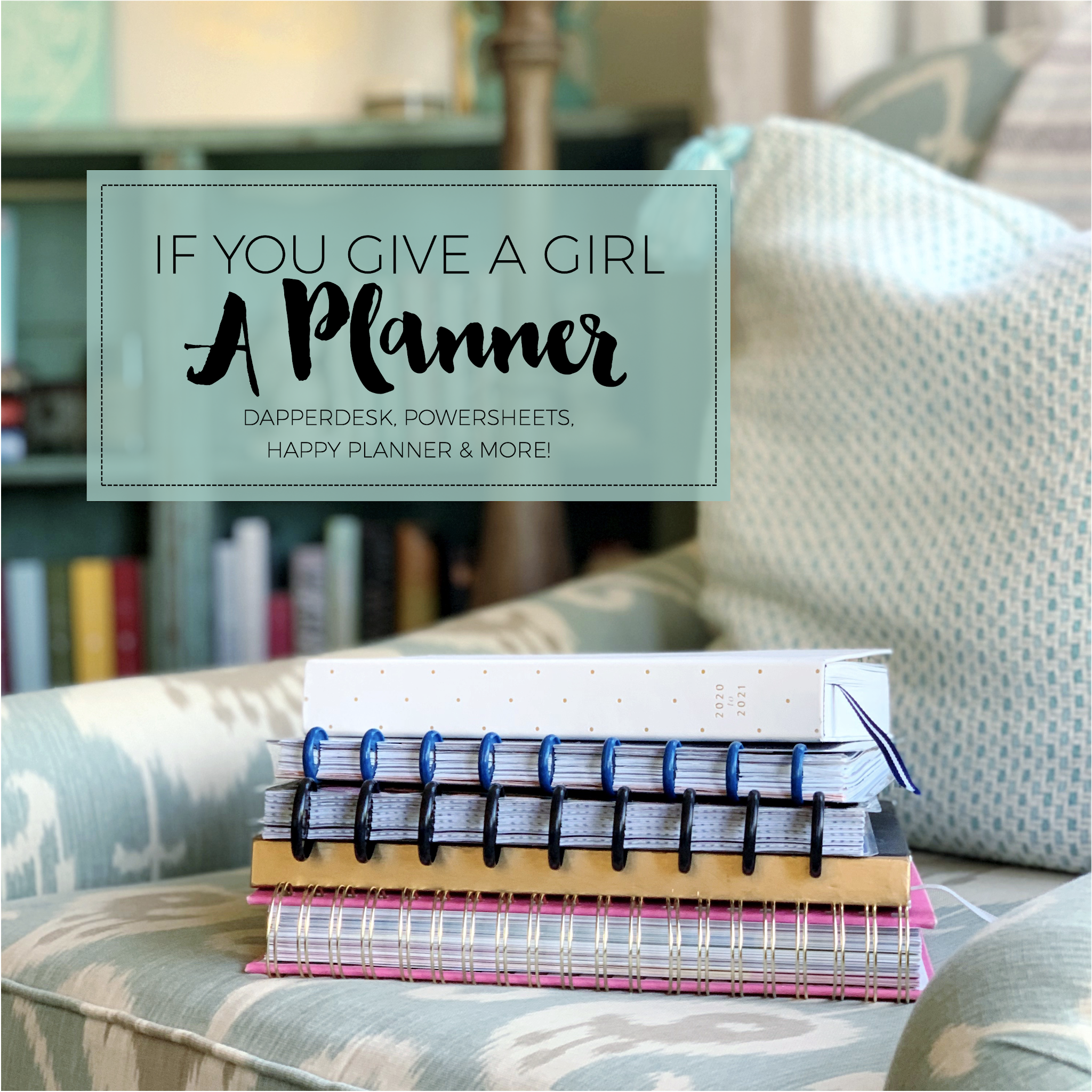
If you give a girl a planner, she's going to ask you for a pen, some stickers... and maybe a notebook to go with it. I'm so obsessed with all things paper! I love trying new things and then blogging about it. So, for the next few days, I'm sharing my 2020 planner lineup. I'll talk about what I'm using for my daily life, personal goals, reading log, and bookish notebook. Today's post is all about what keeps my life organized and on track: my daily planner.

The last time I blogged about my planners, in 2018, I'd fallen in love with Happy Planners and used them for my gratitude journal, my life planner, my blogging and bookish planner, and my reading journal. But in the summer of 2019, I realized that my life planner started to feel like a chore. I was frequently writing in it after the fact, and it became more decorative than functional. So, I knew it wasn't working for me anymore. I changed to an academic year Simplified Planner. From August 2019 - July 2020, I used their weekly planner. I never posted about it, but it was exactly what I needed. It was simple, functional, and beautiful. And the weekly format had plenty of space for occasional appointments, a handful of daily to do's, and a little blog planning.

For 2020-2021, I picked Simplified Planner's Dapperdesk. I'd wanted to make the switch to a daily planner for a while, and it finally felt like the right time. So, let's talk about why I chose it and how I feel about it!


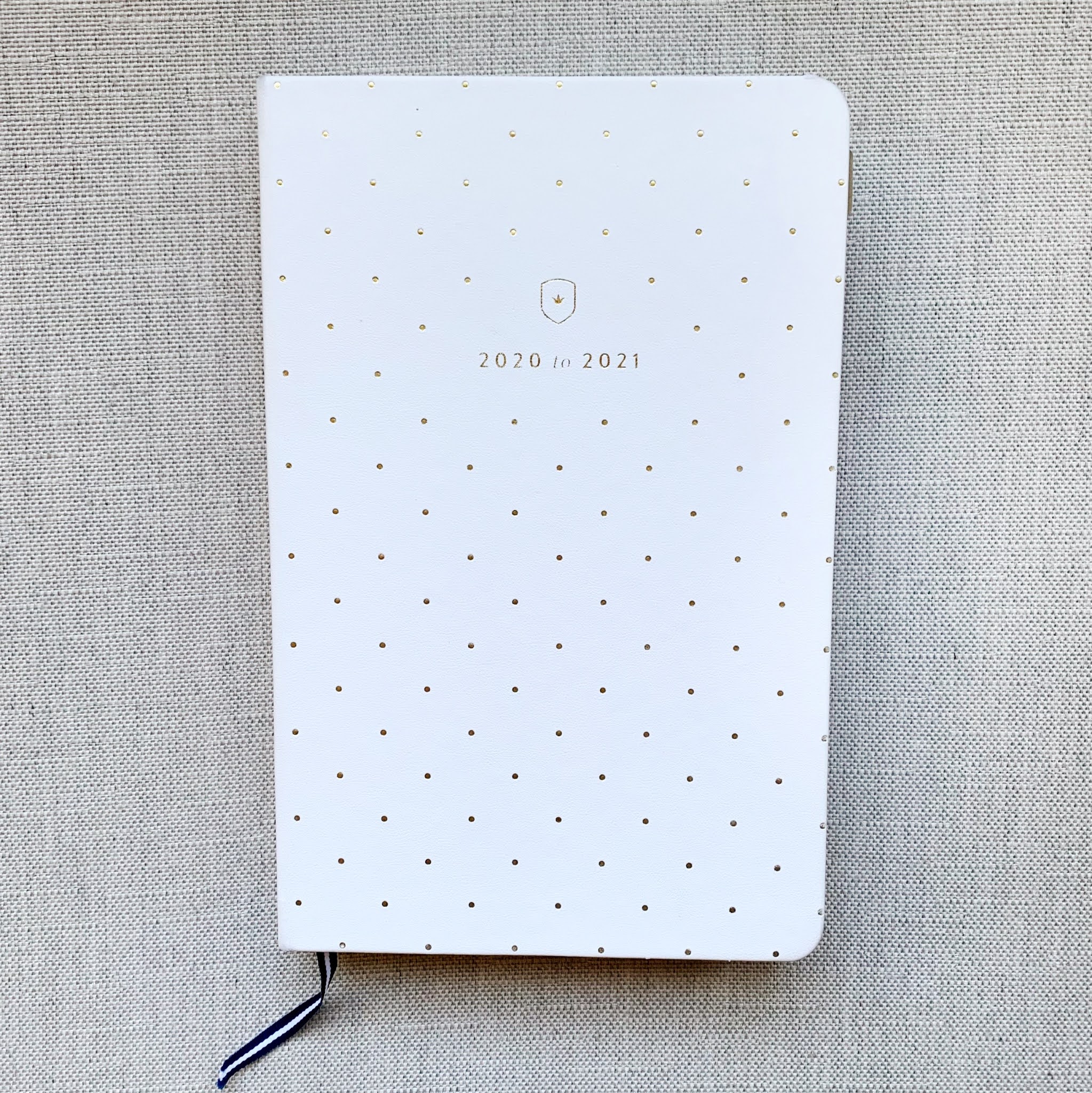
Simplified Planner's Dapperdesk line is their most minimal offering. It is bookbound, like their weekly planner, which works better for me as a lefty than their spiral binding. It covers 12 months – I have the academic year, but the calendar year is available, too. The cover is leatherette, and I love the gorgeous gold dot pattern that I chose.

The inside is their classic daily layout with a few changes – no color, no tabs, all the monthly views at the front, and a full page each for Saturday and Sunday. I wasn't sure I really needed one full page per day, which is one reason I used a weekly last year. I wanted to see whether it felt like enough space and figured that was easier to commit to, especially because my baby was due about halfway through the academic year. It turned out to be exactly what I needed at the time. But for 2020-2021, it was time for a daily. Here's why I chose the Dapperdesk:

+ Classic, minimal look
+ Functional layout
+ Lay-flat book binding (no spiral!)
+ One day per page
+ The in-between size (bigger than their weekly, more portable than their daily)


As I mentioned above, the Dapperdesk doesn't have any tabs and all of the monthly views are together at the front. These were the only two features I was nervous about beforehand, but neither one has annoyed me in my first three months of use. I use the ribbon bookmark to mark the current day, and a small gold Post-It page tab (seen above on the upper right side of the page) to easily flip to the monthly view.

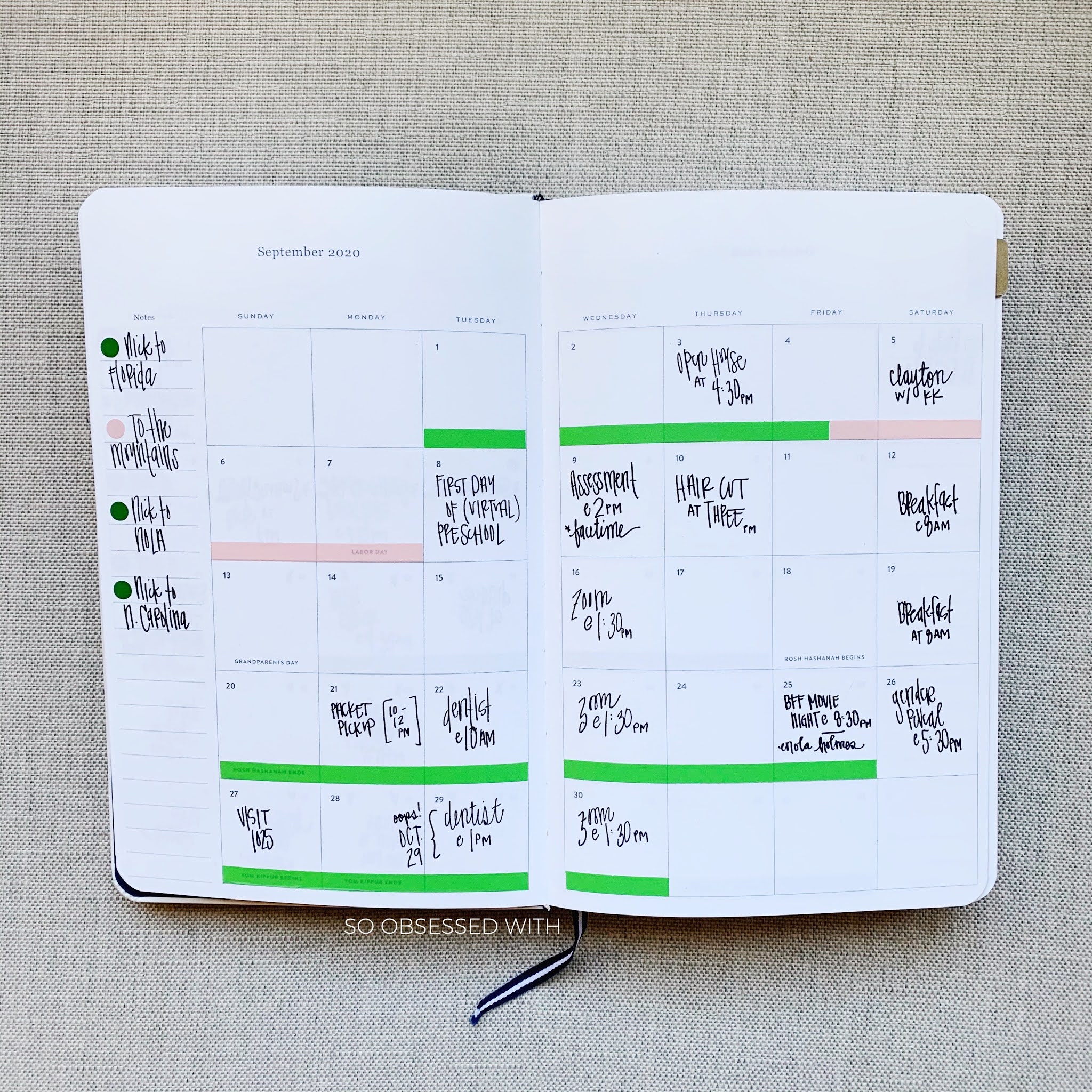
On the monthly spread, I typically write down appointments or events that are happening at a specific time, like my in laws coming over for a Saturday family breakfast. Sometimes I'll add in a more general event, like an adventure to the park with my boys. In the Notes column to the left, I write down birthdays and whatever the washi tape represents. Unlike with my Happy Planner, I rarely use decorative stickers in my Dapperdesk. I do some simple color coding, and use stickers and washi tape when it serves a purpose. Simplified Planner's color-coding stickers come in nine colors, and I've assigned each one a category:

+ Navy: My little boys
+ Green: My husband, Nick
+ Light Blue: My blog
+ Teal (two shades): Meal planning
+ Yellow: Eating out
+ Light Pink: Travel / Adventures
+ Medium Pink: Release (book / music / movie)
+ Dark Pink: Myself

When I use washi, it matches up with my color coding. So, in the photo above, the green is Nick's travel schedule for work and the light pink is our family trip to the mountains. And that's all I do on the monthly view!
 

The best thing about a daily planner is that every day is a fresh start. I never feel like I have to stick to a specific format or regret the placement of a sticker. Just turn the page and try something new tomorrow! I've tried several different things so far, and this is just a peek at one spread. Here's how I'm using the different sections of the page:

+ The hourly column: I usually write appointments or events occurring at a specific time: pest control coming to our house, errands we run, or adventures we go on. And I'll add a dot sticker to a line if an event fits into one of my categories, like a navy dot for my baby's Well Check. Some days this area is completely blank, and that's okay.

+ The to do list column: I almost never write on every line. I don't want to pack that much into my day! In bed each night, I usually spend a few minutes reviewing and prepping in my planner. I'll check off that day's tasks, carry over ones that didn't get done, and add anything new that I already know needs to happen the next day.

+ The Notes section: This is where this planner really wins, in my opinion. You can do anything you want here! I'll meal plan, as you can see in the photo above. I use a little sticker to make note of when I finish a book. I'll write down cute things my big boy says, the baby's milestones, the blog post I published that day, things I want to remember or look up... and so much more. And instead of keeping a separate gratitude journal, I write down one thing that made me happy each day. It's a little bit like having a planner and journal in one, which I love. 

But what about things that can't assign to a specific day? That's when I add in a sticky notes! Sometimes I'll write down a few goals on a sticky note and just move it from day to day. In the photo above, I used a sticky note to pre-plan some extension activities for my son's virtual preschool. His teacher has put a lot of work into making this year special and fun, even at home. But one of my recent goals was to be more proactive about extending his lessons into our daily rhythm. On Sundays, I'll write down his letter, theme, and Bible story of the week along with relevant books we own and could read + extra activities/crafts. Then I can reference it anytime we need something to do, want to reinforce a specific lesson, etc. For Letter D, We went on a Dunkin Donut Date for Letter D and played Find & Seek for Letter F. You get the idea! The planner is just the tool that keeps me organized.


The Dapperdesk planner has 17 notes pages, compared to 31 in the weekly and 4 in the daily. So it's right in the middle, which has been the perfect amount for me (so far). Last year, I barely used those blank pages in my weekly. But this year, I was determined to put them to better use! I looked at my favorite planner account – @plannerstateofmind – for inspiration and then got to work setting it all up. Here's how I'm using my pages:

+ Color Coding Guide: Quick reference for my colors + categories
+ Contact Information: Frequently used addresses and phone numbers
+ Planning Ahead: 2021-2022 appointments past when the planner ends
+ Routines (Daily and Weekly): My daily and weekly household chores
+ Routines (Monthly): Monthly routines for the blog, my planner, photos, etc. 
+ Lessons Learned: Write down what worked and what didn't work
+ Things I Want to Buy for Myself: A wishlist for myself + our house
+ Things I Want to Buy for Others: Gift ideas for my family and friends
+ 20 in 20 Family Bucket List: The same list I shared on the blog
+ 2021 Family Bucket List: A spot for our 2021 list, once I've made it
+ Things for Our Family to Try: Local adventures, activities at home, and places to visit
+ Memories and Milestones: Highlights from our year
+ Goals I Want to Accomplish: Projects I want do, habits I want to start, etc.
+ Celebrate the Wins: Goals I've checked off my list and progress I've made
+ Ideas for So Obsessed With: Brainstorming blog posts
+ Two blank pages: For whatever strikes my fancy!

If you're curious, here's a full flip through of the Dapperdesk planner:


Now that you've gotten to see inside, here are the accessories I typically use. They're mostly just functional: 

+ Simplified Planner stickers, including:
    - Flag Labels
    - Happy Icons 
    - Flags
+ A few FayeCreates stickers
+ Some honeyinked icon stickers
+ Thin washi, like this pack from Recollections

Well, there you have it: my 2020-2021 planner for daily life! I'm loving it so far, and I think my only con has to do with the cover. As much as I love the look, I'm still a little worried the gold dots will wear off the longer I use it. And I've noticed one or two spots where the leatherette has gotten a little scratched off, like the time I caught the edge of the planner on the pouch's zipper. Other than that, I love everything about it so far!

If you'd like to try Simplified Planner, you can get $10 off your first order with this affiliate link.

Do you use a paper planner? Tell me about it!
And check back tomorrow for my Powersheets goal planner.

If You Don't Like These, Then I Have Questions...

Oct 22, 2020


Kelly and I were talking recently about recommendations from other readers and how no one – not even your best friend! – can perfectly predict your book taste. One thing that I love about bookstagram, blogging, and Goodreads is that there are always books on my radar. Whether it's a new release from a favorite author or a backlist book I've never even heard of, I'm never lacking in options. But how do I choose? I look at reviews!

Over time, you might start to learn other readers taste and things about your own. For example, if someone says that a book didn't have enough character development, I know that might be a dealbreaker for me, too. But if their problem was a love triangle, I won't hesitate to pick up the book if the story interests me. There are a few readers I trust more than others, based on how well I know their taste and how much we have in common.

But have you ever seen a trusted reviewer feel negatively about a book you LOVE? It can throw me for a loop! I love how personal reading is, how deeply you can connect to a story or character, and how much emotion it can evoke. But I won't lie, sometimes it can feel like a personal attack if someone criticizes a book I love. Usually, I'm pretty chill because I know that no book can please everyone, but some just hit a little closer to home. Kelly and I were joking about the fact that there are some books that make you want to say, "If you don't like this book, then I don't like YOU!" Yes, we sound like lunatics... but trust me, we were laughing as we said it.

That made me think: what books or authors would be on my list? I came up with six! There are so many other books that I feel passionately about, but most are ones where I can rationally understand how someone wouldn't like them as much as I do. I adore the Throne of Glass series, but I can see how fantasy isn't for everyone. I can't get enough of Cormoran Strike, but dark and gritty mysteries aren't for the faint of heart. You get the idea!

You don't have to love these six. But if you don't even like them, then I might have Questions about your taste...

1. Anne of Green Gables by L.M. Montgomery
Anne of Green Gables is one of the books I credit with making me a reader. It's a book I collect, a character I deeply love, and a story that feels like home. I do think there's an extra magic to Anne if you find her in childhood, so I can have some grace for readers who don't meet her until adulthood. But be careful what you say about her!

2. Melina Marchetta. All of them, but The Piper's Son is pictured.
It doesn't matter what Melina writes, I want it. She's written for adults and teens, in multiple genres (fantasy, contemporary, mystery), and has never let me down. While I don't love them all equally, Marchetta can do no wrong. She's got complex characters, brilliantly plotted stories, deep emotion, and more. You better recognize it!

3. Mhairi McFarlane. I'll allow one least favorite, as long as it's not If I Never Met You.
Are there any authors/books that you love so much that you hesitate to recommend them to people? You don't want to share! That's how I feel about Mhairi. I want her to be successful, so I truly do hope everyone reads her books. But deep in my heart, I don't want anyone to know about them but me. How's that for psycho?
 
4. Happiness for Beginners by Katherine Center
It's been five years, but I can still remember picking up a copy of Happiness for Beginners while standing in Target's book section. I didn't know then that it would become a book that I'd return to again and again. I love this story, the romance, and the characters, but it's the message at the heart that has had such a profound impact on me. 

5. Pride and Prejudice by Jane Austen
I am obsessed with Jane Austen, through and through. I will read non-fiction, sequels, adaptations, retellings... the works, if they reference Austen. But it's Pride and Prejudice that ultimately has my heart, and I just don't think I can trust a reader who hates it. It's too important to me and is tied so closely to the reader I've become. 

6. Lovely War by Julie Berry
My love for this book is more fresh and not as deeply ingrained by time and repeated re-reads. But the first time I read it, I couldn't think of a thing I would change It's practically perfect in every way, and I wanted to shove a copy into everyone's hands. It won't appeal to everyone, but someone's feelings about it tells me a lot about their taste!

Hopefully you read this in the spirit of fun that it was intended! There are many legit reasons that a book might not work for you and your taste. But I like to think we all have a few books that are so close to our hearts that seeing them criticized makes us feel like Mrs. Weasley facing off against Belltrix, shouting, "Not my daughter, you b*tch!"

What books do you love so much
that you question anyone who doesn't like them, too?

© So Obsessed With • Theme by Maira G.